This year was pretty difficult. Most of the time when somebody says that an English class is difficult, they mean that it was a heavy workload. That is not true at all in this case. When I say it is hard I mean that there is a ton of work, more than I think is necessary but that's not the point, and the work you do is very hard to do. So it is a lot of work which takes a lot of thinking. Had I done my homework everyday in every class I had, this class would have easily taken the most time. It took me probably an hour to an hour and a half on average every other day without doing all of the work. That is a lot in my opinion. Also, it's going to be even harder next year because of the new schedule. I think that all teachers, not just Ms Duke, are going to overestimate the amount of time we have for work everyday and assign way too much work. Sure, they will tone it down some from this year but I think that it won't be enough. Next year's schedule is going to suck.
Pretty much what we did this year was read a lot of books with some papers for some of them. The books we read were, Beowulf, Perceval, The Canterbury Tales, Hamlet, Great Expectations, Frankenstein, Heat of Darkness, and for me Things Fall Apart. I'm going to be straight forward and say that most of these books were terrible, because they were British, except for Things Fall Apart which was Nigerian. I learned lots of things from this class but one of the main things is that I do not want to ever learn any thing more about British literature. It's hard to explain but I enjoyed the class, but not the subject of the class. That's probably because most every class somebody got made fun of by Ms Duke. That was pretty funny.
The main movements we studied this year were the Beowulfian and Percavelian eras. I forgot what they are specifically called. Then we went on to Shakespearean, and after that to Victorian, then to Romantic, then to modernism/post colonialism and then finally to post modernism. A few of these were almost exactly the same characteristics as American literature, such as modernism and romanticism.
This was a hard class that involved a lot of work, but it was a very entertaining class.
Wednesday, May 21, 2008

Sunday, April 13, 2008
Outside Reading Progress Report
I have finished the book now and I have to say that I really liked it a lot. It included many interesting facts about the culture of African tribes and other things about their unique life. Last time, I stopped reading after Okonkwo killed Ikefema(sp?). The book got a whole lot better after that because I started to see what happens whenever the tribe's rules are broken. Whenever the men fire their guns at the funeral, it is completely accidental and unlucky that Okonkwo's gun explodes and kills the mans son. According to the tribe rule, Okonkwo must take his family into seven years of exile because of his actions. Then after his exile, the missionaries come to his old town. Whenever Okonkwo goes back, he tries to lead a rebellion by killing one of the head honchos from the missionary. But, nobody follows him and he has to resort to hanging himself to end his guilt or hate of himself.
I think that some good discussion questions would be "Why do you think Okonkwo felt that he had to hang himself?" Also, "What do the missionaries do for the story?" Lastly, "Do you think that Okonkwo turned out a failure like his father?"
I think that some good discussion questions would be "Why do you think Okonkwo felt that he had to hang himself?" Also, "What do the missionaries do for the story?" Lastly, "Do you think that Okonkwo turned out a failure like his father?"
Modern Art
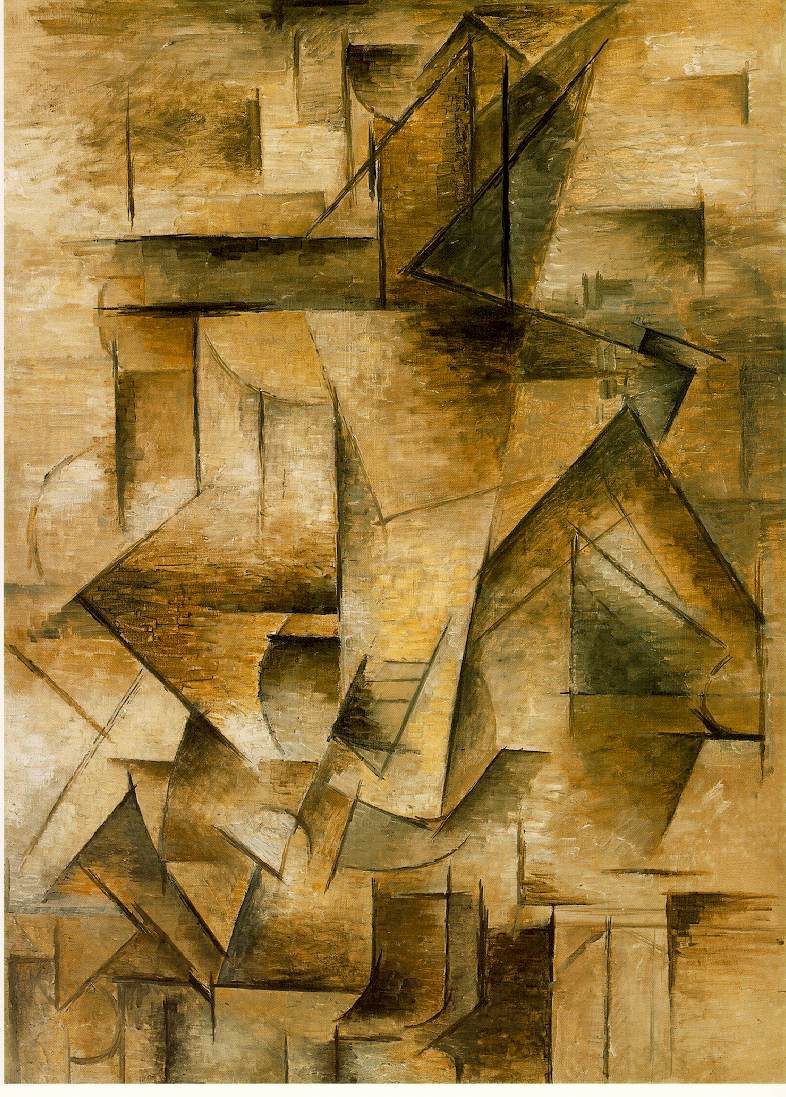
This is a painting by Pablo Picasso. I found it using google images after making certain that Picasso was a modern artist. I believe that this painting is in the style of cubism. In cubism, an object is broken up into different pieces that vary by different viewpoints. Like, the back of a guitar will be pictured on the front of the guitar. Cubism also highlights an overall modern topic of breaking tradition. This painting is obviously very non traditional. Also, cubism was known for highlighting alienation, but I have no idea how that correlates to this painting. This painting can represent two things for me. The first is a guitar and was pretty hard for me to see at first. But, the curve at the base of the painting is the curve of the guitar body. Follow that up and you see the neck and the rest of the guitar. The other interpretation of this painting is a person dancing around. The person is kind of shaped like a stick figure and appears to be dancing around. Overall, it's not very colorful, but it is still interesting to look at.
Sunday, April 6, 2008
Vocab Internet Thing Part 2
Prevail - "Despite the Barack Obama zeal, I believe Clinton will prevail. And if she is the nominee, I believe she is the most electable and least vulnerable Democratic candidate to face the Republicans." This is just another one of those political websites. I don't think that they have any clue about what will happen. Nobody does. This word will be used quite often.
Putrefy - "Death was once easily recognised by the absence of breathing and heart beat because such people inevitably went on to putrefy." Kind of gross, but it was the only thing that I could find with this word in it. Putrefy will probably be one of those words that I will never use. I will probably just use decay instead.
Salubrious - "Linton had grown tall of his age, still wanting some months of sixteen. His features were pretty yet, and his eye and complexion brighter than I remembered them, though with merely temporary lustre borrowed from the salubrious air and genial sun." This is a quote from Wuthering Heights. I included it because it is a famous book. I might use this word if I need to convince somebody to quite smoking. I could say it is not salubrious to your health.
Succulent - "On my first few visits to Hong Kong, I explored the fabulous universe of Chinese food: Succulent Peking duck, delicate Cantonese, fiery Sichuan, rich Shanghainese, exotic Chiu Chow and that world unto itself, dim sum. It ruined Chinese food at home forever." This is a quote of a guy talking about how good the Chinese food is in China. This is a word that I use often as it is today.
Tundra - "Research from ancient sediment cores indicates that a warming climate could make the world's arctic tundra far more susceptible to fires than previously thought." This is another one of those saves the trees topics. I don't know what to think. I guess I would use this word whenever I am talking about the arctic.
Unequivocal - "In a bleak and powerful assesment of the future of the planet, the leading international network of climate change scientists concluded for the first time Friday that global warming was "unequivocal" and that human activity was "very likely" to blame. The warming will continue for hundreds of years, they predicted." This quote is another global warming topic blaming people and not doing anything about it. But I guess they might not be able to do anything. I would use unequivocal when I am trying to prove a point.
Vicissitudes -"The film - written, directed and narrated by documentary filmmaker Martyn Burke, and produced by Frank J. Gaffney Jr. and Alex Alexiev of the Center for Security Policy, a Washington think tank - portrays the vicissitudes of genuine Muslim moderates who support Western freedoms and oppose terror. It also details the lengths to which radicals have gone to suppress their Muslim critics." This is a review or summary of a film about the muslim way of life. I might use this word if I am trying to sound smart. Other than that, I might not use it very much.
Putrefy - "Death was once easily recognised by the absence of breathing and heart beat because such people inevitably went on to putrefy." Kind of gross, but it was the only thing that I could find with this word in it. Putrefy will probably be one of those words that I will never use. I will probably just use decay instead.
Salubrious - "Linton had grown tall of his age, still wanting some months of sixteen. His features were pretty yet, and his eye and complexion brighter than I remembered them, though with merely temporary lustre borrowed from the salubrious air and genial sun." This is a quote from Wuthering Heights. I included it because it is a famous book. I might use this word if I need to convince somebody to quite smoking. I could say it is not salubrious to your health.
Succulent - "On my first few visits to Hong Kong, I explored the fabulous universe of Chinese food: Succulent Peking duck, delicate Cantonese, fiery Sichuan, rich Shanghainese, exotic Chiu Chow and that world unto itself, dim sum. It ruined Chinese food at home forever." This is a quote of a guy talking about how good the Chinese food is in China. This is a word that I use often as it is today.
Tundra - "Research from ancient sediment cores indicates that a warming climate could make the world's arctic tundra far more susceptible to fires than previously thought." This is another one of those saves the trees topics. I don't know what to think. I guess I would use this word whenever I am talking about the arctic.
Unequivocal - "In a bleak and powerful assesment of the future of the planet, the leading international network of climate change scientists concluded for the first time Friday that global warming was "unequivocal" and that human activity was "very likely" to blame. The warming will continue for hundreds of years, they predicted." This quote is another global warming topic blaming people and not doing anything about it. But I guess they might not be able to do anything. I would use unequivocal when I am trying to prove a point.
Vicissitudes -"The film - written, directed and narrated by documentary filmmaker Martyn Burke, and produced by Frank J. Gaffney Jr. and Alex Alexiev of the Center for Security Policy, a Washington think tank - portrays the vicissitudes of genuine Muslim moderates who support Western freedoms and oppose terror. It also details the lengths to which radicals have gone to suppress their Muslim critics." This is a review or summary of a film about the muslim way of life. I might use this word if I am trying to sound smart. Other than that, I might not use it very much.
Works Cited
Cliffsnotes. “What Does it Mean to Be Salubrious.” Cliffsnotes. 2008. 6 Apr. 2008
James, Jamie. “Travel and Food.” Salon Travel. 2000. 6 Apr. 2008
Rosenthal, Elizabeth. “Global Warming Called Unequivocal.” The Herald Tribune. 2008. 6 Apr. 2008
Tobin, Jonathon. “View From
Wade, Derrick. “The Dis-Integration of Death.” Science Direct. 2002. The Lancet. 6 Apr. 2008
“Warming Climate May Cause Arctic Tundra to Burn.” Science Daily. 2008. Science Daily. 6 Apr. 2008
Vocab on the Internet
mAttenuate - "Regular use of a hand cream can attenuate skin dryness and roughness caused by frequent hand washing." I thought that this was pretty interesting. I didn't think that you could wear your skin down that much by washing your hands. I guess you could use this word while working on making any type of craft that needs sanding.
Behemoth - "I have traveled many miles by air during my working life and the A380 symbolyzes all the worst aspects of air travel. Overcrowded passenger areas, lugage delays, security farces, and lines of people for every service, from toilets to rental cars. I wonder if the marketers ever asked any passengers before they came up with this behemoth of an airplane." This is about the gigantic airbus plane. This guy obviously does not like it at all. This word would be pretty easy to use. Anytime you want to describe something huge, this word would be perfect.
Disinter - "Southern Baptist officials today denounced efforts by leaders of a small south Georgia church to disinter the body of a mixed-race baby who was buried last week in the church's all-white cemetery." This I find disgraceful. I can't believe that some crazy baptists are going to dig up an infant because it is not white. Unbelievable. I don't think that I would ever use this word. I would just say dig up a body. Too many people I think would not know what it means.
Impinge - "Shoulder impingement syndrome is caused by compression of the tendons of the rotator cuff between a part of the shoulder blade and the head of the humerus. This can become a chronic inflammatory condition that may lead to a weakening of the tendons of the rotator cuff, a situation that may result in a torn rotator cuff." This peaked my curiosity because it sounds like it could be an injury from baseball. It also sounds pretty painful. This word could be used very often. Whenever someone or something gets to close say, "hey your inmpinging me again.
Plenitude - "CFD Elettronica's Plenitude Premium is an embedded Linux-based home intrusion detection system with cameras tripped by infrared sensors. It includes 32 fully wireless sensors with a claimed battery life of three years, and can send images to mobile phones using any of three wireless protocols." This is an advertisement for some security system. Maybe they mean the there is an ample amount of protection. I can see using this word more frequently in the future.
Postulate - "The theory of special relativity can be derived formally from a small number of postulates. The fundamental postulates of special relativity can be expressed in various ways; you may find different versions of them in different books." This quote just says that the theory of special relativity is made up of several postulates or hypothesis. I might use this word is AP Bio or AP Physics next year.
Behemoth - "I have traveled many miles by air during my working life and the A380 symbolyzes all the worst aspects of air travel. Overcrowded passenger areas, lugage delays, security farces, and lines of people for every service, from toilets to rental cars. I wonder if the marketers ever asked any passengers before they came up with this behemoth of an airplane." This is about the gigantic airbus plane. This guy obviously does not like it at all. This word would be pretty easy to use. Anytime you want to describe something huge, this word would be perfect.
Disinter - "Southern Baptist officials today denounced efforts by leaders of a small south Georgia church to disinter the body of a mixed-race baby who was buried last week in the church's all-white cemetery." This I find disgraceful. I can't believe that some crazy baptists are going to dig up an infant because it is not white. Unbelievable. I don't think that I would ever use this word. I would just say dig up a body. Too many people I think would not know what it means.
Impinge - "Shoulder impingement syndrome is caused by compression of the tendons of the rotator cuff between a part of the shoulder blade and the head of the humerus. This can become a chronic inflammatory condition that may lead to a weakening of the tendons of the rotator cuff, a situation that may result in a torn rotator cuff." This peaked my curiosity because it sounds like it could be an injury from baseball. It also sounds pretty painful. This word could be used very often. Whenever someone or something gets to close say, "hey your inmpinging me again.
Multifarious - "Euglena Light-Harvesting Complexes Are Encoded by Multifarious Polyprotein mRNAs that Evolve in Concert." This was one of the only site that I could find this word on that was not a dictionary site. I have no idea what this sentence means. All I know is that it has something to do with chromosomes and biology. I don't think that this word will be very useful later in my life.
Oxymoron - " The juxtaposition of two contradictory ideas is oxymoron, from the Greek words for "sharp" and "foolish." Everybody's favorite examples are facetious ("military intelligence"), but poets can often use oxymoron for striking effects (such as Milton's "darkness visible")." This quote is mostly a definition but it also gave me where the word came from. Also, military intelligence is kind of funny. Maybe. Whatever, I use this word from time to time.Plenitude - "CFD Elettronica's Plenitude Premium is an embedded Linux-based home intrusion detection system with cameras tripped by infrared sensors. It includes 32 fully wireless sensors with a claimed battery life of three years, and can send images to mobile phones using any of three wireless protocols." This is an advertisement for some security system. Maybe they mean the there is an ample amount of protection. I can see using this word more frequently in the future.
Postulate - "The theory of special relativity can be derived formally from a small number of postulates. The fundamental postulates of special relativity can be expressed in various ways; you may find different versions of them in different books." This quote just says that the theory of special relativity is made up of several postulates or hypothesis. I might use this word is AP Bio or AP Physics next year.
Works Cited
“CFD Elettronica Plenitude Premium wireless home intrusion detection system.” Linux Devices. Linux Devices. 6 Apr. 2008
Koziol, Adam G, and Dion G Durnford. “Molecular Biology and Evolution.” Oxford Journals. 2008. Oxford Journals. 6 Apr. 2008
Lynch, Jack. “Oxymoron.” Oxymoron. Rutgers University. 6 Apr. 2008
Matlack, Carol. “Airbus’ Behemoth Hits Turbulence.” BusinessWeek. 14 June 2006. BusinessWeek. 6 Apr. 2008
Medical Internet Solutions. “Shoulder Impingment Syndrome.” Shoulder Solutions. 2001. Medical Internet Solutions. 6 Apr. 2008
Nature.com. “Commensal anaerobic gut bacteria attenuate inflammation by regulating nuclear-cytoplasmic shuttling of PPAR-big gamma and RelA.” Nature Immunology. 21 Dec. 2003. Nature.com. 6 Apr. 2008
“The Postulates of Special Relativity.” The Postulates of Special Relativity. 1998. University of Colorado. 6 Apr. 2008
Sack, Kevin. “Anger Over Effort to Disinter An Infant of Mixed Race.” The New York Times. 6 Apr. 2008. The New York Times. 6 Apr. 2008
Sunday, March 30, 2008
Outside Reading Interpretation
I think that "Things Fall Apart" is a very interesting book because it presents a different style of writing from what I am used to. Most of the books I have read have been very well written and seem to flow perfectly from one sentence to another. In "Things Fall Apart," the sentences seem much more choppy than other, say English literature books. I think that the author is using this effect to possibly represent how the tribe memberes interact with each other. I also find it interesting how the author always describes things in a unique way. Instead of saying that something was blue and leave it at that, this author says "something was as blue as the sky on a day during the harvest season" or something like that. I guess what I am trying to say is that he uses lots of natural and physical objects in his similies and metaphors.
As well as the interesting similies, this book has an interesting way of characterizing different characters other than Okonkwo. It seems as if all the other characters are compared to Okonkwo and that is how the reader gets their ideas about a certain character. How they differ from Okonkwo. His father was not like Okonkwo, his son was not at all like himself. Different things like this. Mainly though, this only applies to the male characters, it is kind of hard to compare and contrast a man and a woman in this culture because the serve such different purposes.
The last thing I will talk about is the culture of this book. It is a real shock how they live there. Killing an innocent boy from a neighboring village because his dad raped a daughter of Okonkwo's village seems a little bit extreme. I also find their gods and religious traditions to be somewhat interesting to read about. It is strange that everyone has their own chi or their own personal god. There must be thousands of gods over there. Lastly, it was a little difficult to get the names down at first but I think I can pronounce them in my head now.
As well as the interesting similies, this book has an interesting way of characterizing different characters other than Okonkwo. It seems as if all the other characters are compared to Okonkwo and that is how the reader gets their ideas about a certain character. How they differ from Okonkwo. His father was not like Okonkwo, his son was not at all like himself. Different things like this. Mainly though, this only applies to the male characters, it is kind of hard to compare and contrast a man and a woman in this culture because the serve such different purposes.
The last thing I will talk about is the culture of this book. It is a real shock how they live there. Killing an innocent boy from a neighboring village because his dad raped a daughter of Okonkwo's village seems a little bit extreme. I also find their gods and religious traditions to be somewhat interesting to read about. It is strange that everyone has their own chi or their own personal god. There must be thousands of gods over there. Lastly, it was a little difficult to get the names down at first but I think I can pronounce them in my head now.
Saturday, March 29, 2008
Third Quarter Reflection
I thought that third quarter was much harder than second or first quarter. There was a lot more work and most of the work was more difficult. First semester, the blogs were easier, the topics were not as in depth as they were for third quarter. The third quarter blogs were mostly on an assortment of topics mainly about the book we were reading about. They were difficult because they asked us to discuss and analyze the books we read. Some of the time, they were more difficult because I had not done the reading. That makes it a little more difficult to complete the assignment. They are a lot harder if you just skim. But that wasn't the whole reason this quarter was harder. Most of it was because of the layer project. I was surprised how quickly the work caught up on me. Pretty much, third quarter was difficult because I made it difficult. That will not happen this quarter.
Tuesday, March 18, 2008
Irish Modern Author
William Butler Yeats was a very popular and famous Irish author from the early 1900's. He was born in Sandymount, County Dublin. He helped start the Irish Literary Rival. Also, he helped to found Abbey Theatre with Lady Gregory and Edward Martyn. In 1923, he received the Nobel prize for literature for "inspired poetry, which in a highly artistic form gives expression to the spirit of a whole nation." He is one of the very few authors who's best work comes after receiving the award. Some of his most famous poem include "The Black Tower" and "The Winding Stair." At first, Yeats' subjects were mainly the Irish legends and the occult as well as transcendentalism. Later in his life, however, he turned to write more on physically tangible things and focused more on realism. He died on January 28, 1939.
The Black Tower
SAY that the men of the old black tower,
Though they but feed as the goatherd feeds,
Their money spent, their wine gone sour,
Lack nothing that a soldier needs,
That all are oath-bound men:Those banners come not in.
There in the tomb stand the dead upright,
But winds come up from the shore:
They shake when the winds roar,
Old bones upon the mountain shake.
Those banners come to bribe or threaten,
Or whisper that a man's a fool
Who, when his own right king's forgotten,
Cares what king sets up his rule.
If he died long ago
Why do you dread us so?
There in the tomb drops the faint moonlight,
But wind comes up from the shore:
They shake when the winds roar,
Old bones upon the mountain shake.
The tower's old cook that must climb and clamber
Catching small birds in the dew of the morn
When we hale men lie stretched in slumber
Swears that he hears the king's great horn.
But he's a lying hound:
Stand we on guard oath-bound!
There in the tomb the dark grows blacker,
But wind comes up from the shore:
They shake when the winds roar,
Old bones upon the mountain shake.
The Black Tower
SAY that the men of the old black tower,
Though they but feed as the goatherd feeds,
Their money spent, their wine gone sour,
Lack nothing that a soldier needs,
That all are oath-bound men:Those banners come not in.
There in the tomb stand the dead upright,
But winds come up from the shore:
They shake when the winds roar,
Old bones upon the mountain shake.
Those banners come to bribe or threaten,
Or whisper that a man's a fool
Who, when his own right king's forgotten,
Cares what king sets up his rule.
If he died long ago
Why do you dread us so?
There in the tomb drops the faint moonlight,
But wind comes up from the shore:
They shake when the winds roar,
Old bones upon the mountain shake.
The tower's old cook that must climb and clamber
Catching small birds in the dew of the morn
When we hale men lie stretched in slumber
Swears that he hears the king's great horn.
But he's a lying hound:
Stand we on guard oath-bound!
There in the tomb the dark grows blacker,
But wind comes up from the shore:
They shake when the winds roar,
Old bones upon the mountain shake.
Monday, March 3, 2008
Vocab Conversations
Well to start off, I had a couple of conversations at baseball games this week. I tried to use some of the words and was made fun of for sounding funny. For example, I used the word assuage when Michael Guery asked me what I was doing with Jared. Jared had just made an error and I said, "I was trying to assuage Jared because of the error he made." The second word I used was epigram. A freshman on the team commented on the amount of sayings coach counts has like turn the light switch on, and you have to be mentally prepared. So, after he commented on this, I said, "Yeah, he does have a lot of epigrams." Next, another freshman asked what Michael Guery's dad does for a living. I said, "I think that he is some sort of stock mogul." And then he asked what is a mogul, so I told him. After the second game, we went to go get some cane's. As we were going, Kramer almost drove off the road. We all screamed at him and he said, "What did I do?" I then said, "You almost careened off the road dumba$$." Next after a guy hit a homerun during a game that I was not participating in, the entire dugout on his team went crazy. I turned to Coach Hawke and said, "Man, they are pretty frentic right now." And he said, "Yeah, they should be." Then after the game on the next day, we went to McDonalds for food. Somebody got a bigmac and I said, "That looks repulsive." The only thing I will eat from McDonalds is chicken sandwiches. On the last day of games, Coach Hawke played some new music on the sound system inbetween innings. "I looked to him and said, "This music has a pretty good cadence." It was music by Cream. The next one, I didn't say, but coach counts did. He said to the whole team, "I am issuing an official edict, everyone has to retrieve at least two foul balls today." So, I went down to the creek and found four. Then, I got pretty mad because a lot of people left early. Coach Wilkins asked me where they all went and I said, "I don't know, but we sure do have a lot of renegades on this team." And he left. Then for the championship game, Uhigh almost lost the game in the last few minutes of the game. I told matthew Johnson, man that was a pretty big debacle right there. He laughed because he knew I was doing work for english. After the game, I went with Michael to the woods to look for foul balls. Down there, I was chopping off leaves of trees for fun. He asked what are you doing, i said, "I am defoliating trees. Then once we jumped the creek in the woods, I noted that, "It was very verdant there because of the recent rain." Once I got home, I told my parents that, "It is nice to be back at my domicile after 12 hours at the field." I then saw my dad, working on something and I asked him, What are you fabricating, he said, "Nice vocabulary, a door for the living room." Lastly, my parents asked me what I wanted for dinner, and I said sarcastically, "I think that I have a proclivity to liver and onioins.
Saturday, March 1, 2008
GE Reading 2
I thought that this section was a little bit more boring than the last section. It seems that Dickens made the beginning more interesting so that the reader would be drawn into the book more. This is evident with the whole stealing and action scenes with the convicts. In the second section, there seems to be more of a focus on the themes that Dickens is trying to explain. I think the major one from the first two readings is the role of the classes in Victorian Society. Havisham and Estella are kind of weird and sometimes mean and rude towards Pip, and we find that Biddy, a common girl, is more sincere and nice to Pip. I think that Dickens is trying to show his dislike of the upper class and show that they are somewhat snobbish.
Also, I have noticed a change in Pip. Because he is now accustomed to the upper class and how they think, he has started to think like them. He judges people by how much money they have or their status. He looks down on Biddy because she is not like Estella, and calls Joe an idiot. I think that Pip will learn some self knowledge throughout the book.
Also, I have noticed a change in Pip. Because he is now accustomed to the upper class and how they think, he has started to think like them. He judges people by how much money they have or their status. He looks down on Biddy because she is not like Estella, and calls Joe an idiot. I think that Pip will learn some self knowledge throughout the book.
Thursday, February 28, 2008
Vocab Test Reflection
I did absolutely terrible on the vocab exam. Yes, I say exam because it was huge. I don't mean to be rude but how can a project that has been in progress for over a month only be worth 50 more points than a vocab exam. I know vocab is important but shouldn't understanding the themes and romantic characteristics of Frankenstein be more important for our overall knowledge of English. I do. I think that the vocab test should have been 1 point per question or the layer project should be 200 points. Okay, now on to the analysis of the vocab exam. I thought it was easy when I took it. I studied the words for thirty minutes for three nights before the test and I thought that I was well prepared. It must have had lots of tricks because I felt that I knew the words, obviously, but I was extremely incorrect. I don't know if there were any tricks, but It felt like there were, and if there were tricks I think that that is not necessarily unfair, but very annoying. I believe that vocab exams should test the knowledge of the word, not someones ability to pickup on small tricks in the question. Coincidentally, I think that the SAT is complete BS. Imagine that!
Wednesday, February 27, 2008
GE Reflection Chapters 1-9
From the beginning of this book, I have started to see some interesting themes emerging. One of them being the upper class versus the lower class. Pip represents the lower class and Miss. Havisham represents the upper class for now. We don't know if any other rich people or people in power will show up in the book. In fact, we don't know if any lower class people won't show up. She isn't really mean but she isn't nice to Pip. She seems to want Pip and Estella to get together. She says stuff like "Isn't she pretty." She just seems pretty crazy. She keeps a 50 year old feast out in the open. That is pretty strange. I am pretty sure that Dickens is trying to say something about the class structure in the Victorian period, I'm just not sure what.
Another theme that is emerging is right versus wrong. This is the first one that the reader sees. It is most clearly shown in how Pip steals food and a file for a convict. This is wrong on two levels. First off, he is stealing. Second, he is helping a criminal which I think is against the law. I also believe that Dickens uses this situation to help characterize Pip. After he has stolen the food, he is very scared that he will get caught by the police. Also, he seems to be very remorseful. This shows us that maybe Pip is naturally good, and has a conscience that might help him to do the right thing later on in the story. Who knows.
Another theme that is emerging is right versus wrong. This is the first one that the reader sees. It is most clearly shown in how Pip steals food and a file for a convict. This is wrong on two levels. First off, he is stealing. Second, he is helping a criminal which I think is against the law. I also believe that Dickens uses this situation to help characterize Pip. After he has stolen the food, he is very scared that he will get caught by the police. Also, he seems to be very remorseful. This shows us that maybe Pip is naturally good, and has a conscience that might help him to do the right thing later on in the story. Who knows.
Sunday, February 17, 2008
Frankenstein Overview
I thought that this was a very interesting book. It explores many ideas about creation and what is right and what is wrong. That is what I think the main point of this story is. Once Victor creates the monster, he starts to contemplate if what he did is right or wrong. He starts to think the latter because the monster is going around killing people and just overall messing up Victor's life. Victor thinks that all of these things are happening purely because he thinks that the monster is evil at the deepest levels. But, in actuality, the monster is only evil because of what Victor did. He was negligent towards the monster and abandoned him because he was afraid of the creature he created. During the times that the monster and Victor are separated, Victor becomes increasingly unhealthy. During one of my lit circles, Doug brought up an interesting point. He said that maybe the monster and Victor need to be around each other for Victor to be healthy. It just shows that Victor is feeling guilty because his creation is causing so much grief. Eventually, Victor realizes that what he did was wrong because he did not create a companion for the original monster. I think that Mary Shelly is saying something about creation. Maybe she believes that creation should be left to God. I know it was a little premature but this theme seems strangely relevant to the cloning issues going on today. Overall I thought this book was very good but wasn't the best written book.
Vocab Log
Well, I made a mistake. When my English teacher told my class about our vocab log assignment. I thought that I would do my studying the way I wanted to and then after I had finished I would post one blog entry that would recap my study history. So a couple of days ago, I learned I was supposed to be periodically editing and adding to a post about what I was doing. Well, obviously I cannot do that anymore, but I will still do my original plan and post what I did throughout my study time.
Unit 6
For this unit I decided to make flashcards. I have always used them and they most always worked for me. It does get somewhat repetitive, but I learned the words pretty well in about an hour. I did this unit for about three days and worked on them for about thirty minutes the following two days. I also did some of the activities in the book. I think that I know these words pretty good.
Unit 7
For some reason, I decided to learn these words differently from the previous unit. For this unit, I took every definition and shortened and paraphrased them. Then I would write them down many times. It's just something about writing things down that helps me remember things. I did it a lot during Biology and I liked it and thought that I might do it again. As I did last time, I did a few of the more important activities in the book.
Unit 8
I again made flashcards for this unit and did some of the activities for this unit. This unit was the most difficult for me. I just didn't know as many as these words and it took me longer to memorize what they meant. Some of the words such as triumvirate and votary were unusual and strange to me and took some more time to learn.
Unit 9
This was by far the easiest section for me to learn. I wanted to see if a combination of writing down the definitions and making flashcards would help me any. Unfortunately I have no idea if the section was made easier by combining my two techniques or because the words were easier. I think it is probably a combination of both.
I think that I am well prepared for this quiz
Unit 6
For this unit I decided to make flashcards. I have always used them and they most always worked for me. It does get somewhat repetitive, but I learned the words pretty well in about an hour. I did this unit for about three days and worked on them for about thirty minutes the following two days. I also did some of the activities in the book. I think that I know these words pretty good.
Unit 7
For some reason, I decided to learn these words differently from the previous unit. For this unit, I took every definition and shortened and paraphrased them. Then I would write them down many times. It's just something about writing things down that helps me remember things. I did it a lot during Biology and I liked it and thought that I might do it again. As I did last time, I did a few of the more important activities in the book.
Unit 8
I again made flashcards for this unit and did some of the activities for this unit. This unit was the most difficult for me. I just didn't know as many as these words and it took me longer to memorize what they meant. Some of the words such as triumvirate and votary were unusual and strange to me and took some more time to learn.
Unit 9
This was by far the easiest section for me to learn. I wanted to see if a combination of writing down the definitions and making flashcards would help me any. Unfortunately I have no idea if the section was made easier by combining my two techniques or because the words were easier. I think it is probably a combination of both.
I think that I am well prepared for this quiz
Layer Project Thoughts
I don't know if anybody else does but I really like layer projects. I like how layer projects give me so many choices for me to get points. Most of the activities are familiar from last year's layer such as the lit circles and the ask the teacher thing. Although I like these projects, it seems that this year's project's activities are worth less points. I remember last years project the vocab quiz was 20 points, I think. But this is just a feeling, I have no idea if it is actually true. This year, the project just seems harder. Right now I have 44 points so I think I have only missed 1 point. Probably on my discussion question. But tonight, I am going to do my other discussion question and tuesday I'll do my other lit circle and probably an ask the teacher. By that point, hopefully I will have 75. By that point I am going to have to do the difficult assignments. Its going good so far. Oh, one more thing. I think that 10 points for a 5 minute speech is to little. Speeches are difficult, I think it should be more like 15-20 points.
Wednesday, January 30, 2008
She was a Phantom of Delight Analysis
She was a phantom of delight
When first she gleam’d upon my sight;
A lovely apparition, sent
To be a moment’s ornament;
Her eyes as stars of twilight fair;
Like Twilight’s, too, her dusky hair;
But all things else about her drawn
From May-time and the cheerful dawn;
A dancing shape, an image gay,
To haunt, to startle, and waylay.
I saw her upon nearer view,
A spirit, yet a woman too!
Her household motions light and free,
And steps of virgin-liberty;
A countenance in which did meet
Sweet records, promises as sweet;
A creature not too bright or good
For human nature’s daily food,
For transient sorrows, simple wiles,
Praise, blame, love, kisses, tears, and smiles.
And now I see with eye serene
The very pulse of the machine;
A being breathing thoughtful breath,
A traveller between life and death:
The reason firm, the temperate will,
Endurance, foresight, strength, and skill;
A perfect woman, nobly plann’d
To warn, to comfort, and command;
And yet a Spirit still, and bright
With something of angelic light.
Just to get it out of the way, there is an AB rhyme scheme throughout the poem. And now on to the stuff that's important. This poem is pretty much about the spirit of some woman. The speaker notices this spirit and vividly describes her as being very graceful and free, as most spirits are. The first stanza gives the audience some detailed imagery about what this spirit looks like, dusky hair and her eyes like stars. In the second stanza, the speaker gets a closer look at the spirit and notices that she is a woman of liberty. Which I think means that this spirit does what it wants. Because of the second line in the last stanza, I don't know what to think about this poem. The mention of this woman spirit having the pulse of a machine disuades me from thinking that she is a spirit and more tied down and can't do what she wants to. Another interpretation of this poem could be the type of woman that Wordsworth wants to get to know.
As for romantic elements, I think the most obvious is the solitude and solemness of the spirit. It is the lone subject of the poem and is the only thing that the speaker concentrates on. THe last line of the second stanza mentions actions that go with certain emotions such as love, happiness and sadness. Those three emotions could be what the spirit causes. The last line of the first stanza further reinforces that notion because it says this dancing shape haunts startles and waylays. I've given it my best shot and I hope that I was close. I think that I might have been over thinking this one.
When first she gleam’d upon my sight;
A lovely apparition, sent
To be a moment’s ornament;
Her eyes as stars of twilight fair;
Like Twilight’s, too, her dusky hair;
But all things else about her drawn
From May-time and the cheerful dawn;
A dancing shape, an image gay,
To haunt, to startle, and waylay.
I saw her upon nearer view,
A spirit, yet a woman too!
Her household motions light and free,
And steps of virgin-liberty;
A countenance in which did meet
Sweet records, promises as sweet;
A creature not too bright or good
For human nature’s daily food,
For transient sorrows, simple wiles,
Praise, blame, love, kisses, tears, and smiles.
And now I see with eye serene
The very pulse of the machine;
A being breathing thoughtful breath,
A traveller between life and death:
The reason firm, the temperate will,
Endurance, foresight, strength, and skill;
A perfect woman, nobly plann’d
To warn, to comfort, and command;
And yet a Spirit still, and bright
With something of angelic light.
Just to get it out of the way, there is an AB rhyme scheme throughout the poem. And now on to the stuff that's important. This poem is pretty much about the spirit of some woman. The speaker notices this spirit and vividly describes her as being very graceful and free, as most spirits are. The first stanza gives the audience some detailed imagery about what this spirit looks like, dusky hair and her eyes like stars. In the second stanza, the speaker gets a closer look at the spirit and notices that she is a woman of liberty. Which I think means that this spirit does what it wants. Because of the second line in the last stanza, I don't know what to think about this poem. The mention of this woman spirit having the pulse of a machine disuades me from thinking that she is a spirit and more tied down and can't do what she wants to. Another interpretation of this poem could be the type of woman that Wordsworth wants to get to know.
As for romantic elements, I think the most obvious is the solitude and solemness of the spirit. It is the lone subject of the poem and is the only thing that the speaker concentrates on. THe last line of the second stanza mentions actions that go with certain emotions such as love, happiness and sadness. Those three emotions could be what the spirit causes. The last line of the first stanza further reinforces that notion because it says this dancing shape haunts startles and waylays. I've given it my best shot and I hope that I was close. I think that I might have been over thinking this one.
Monday, January 28, 2008
Preface to Lyrical Ballads Analysis
When I first saw this wall of text, I thought, "Oh man, more extremely difficult junk to understand." But, interestingly enough I found this wall of text to be somewhat enjoyable to read. I had to reread a few paragraphs because I zoned out, but other than that I enjoyed learning one man's opinions on other men from the same time period.
At first, Wordsworth writes about how the first volume of poems was released as an experiment. I believe that his was trying to figure out what made a good poem and what people enjoyed reading. Following that short statement, Wordsworth begins to explain how his friends helped him in learning about poetry. "...I was induced to request the assistance of a Friend, who furnished me with the Poems of..." What Wordsworth means is that he asked his Friends opinion's on what made a good poem. They then gave him a few examples. I believe that after reading those poems, Wordsworth realized that his Friends gave him poems with the exact same style as his own poetry. It really didn't cause any variety to form in his own style. This is when we get to see the first glimpse of self-admiration by Wordsworth. It occurs throughout the preface. Another interesting observation is that Wordsworth capitalized poetry and Friends. I think this might be to show respect for his friends but I really don't have a clue. It could be a typo, who knows.
Following Wordsworth realization that his friend's poems do not add variety to his own style, the reader gets to see Wordsworth critique a fellow poets poem. The poem was written by Thomas Gray, and Wordsworth doesn't think much of it. He writes, "It will easily be perceived that the only part of this Sonnet which is of any value is the lines printed in Italics: it is equally obvious, that, except in the rhyme, and in the use of the single word "fruitless" for fruitlessly, which is so far a defect, the language of these lines does in no respect differ from that of prose." From this quote, we can see that Wordsworth believes that Gray's poetry is really no different than prose. He believes that only a few lines are truly poetic and add style to the poem.
After Wordsworth is done criticizing Gray, he moves on to say that poetic language on a whole is bad. I really don't understand why he would say this after he got done trying to find ways to add variety to his own style. But nonetheless, it was interesting to read what he had to say about how the author must dictate mood and his own personal style. I really think that the main point of this preface was to emphasize the importance of a unique and personal style for every poet. Without that, Wordsworth would probably think the poem was awful.
At first, Wordsworth writes about how the first volume of poems was released as an experiment. I believe that his was trying to figure out what made a good poem and what people enjoyed reading. Following that short statement, Wordsworth begins to explain how his friends helped him in learning about poetry. "...I was induced to request the assistance of a Friend, who furnished me with the Poems of..." What Wordsworth means is that he asked his Friends opinion's on what made a good poem. They then gave him a few examples. I believe that after reading those poems, Wordsworth realized that his Friends gave him poems with the exact same style as his own poetry. It really didn't cause any variety to form in his own style. This is when we get to see the first glimpse of self-admiration by Wordsworth. It occurs throughout the preface. Another interesting observation is that Wordsworth capitalized poetry and Friends. I think this might be to show respect for his friends but I really don't have a clue. It could be a typo, who knows.
Following Wordsworth realization that his friend's poems do not add variety to his own style, the reader gets to see Wordsworth critique a fellow poets poem. The poem was written by Thomas Gray, and Wordsworth doesn't think much of it. He writes, "It will easily be perceived that the only part of this Sonnet which is of any value is the lines printed in Italics: it is equally obvious, that, except in the rhyme, and in the use of the single word "fruitless" for fruitlessly, which is so far a defect, the language of these lines does in no respect differ from that of prose." From this quote, we can see that Wordsworth believes that Gray's poetry is really no different than prose. He believes that only a few lines are truly poetic and add style to the poem.
After Wordsworth is done criticizing Gray, he moves on to say that poetic language on a whole is bad. I really don't understand why he would say this after he got done trying to find ways to add variety to his own style. But nonetheless, it was interesting to read what he had to say about how the author must dictate mood and his own personal style. I really think that the main point of this preface was to emphasize the importance of a unique and personal style for every poet. Without that, Wordsworth would probably think the poem was awful.
Friday, January 18, 2008
Essay Correction Blog
I didn't do very well on this essay, I got an 81, so there is a lot for me to fix. Probably my main problem was that I did not have enough commentary supported by quotes. Furthermore,I used furthermore way to many times. I also changed many words that I thought sounded choppy or words that did not flow very well. For example, I wrote "...because it evokes the most distinct emotions." I changed that sentence to say, "...because it is reminiscent of recongizable emotions." I thought that reminiscent was a better word to use than evokes. It kind of portrays the same emotion as evokes, but it sounds a whole lot better. Another example of using better word choice is in my fourth paragraph when I say, " That characterization instills in the audience the idea of power,..." Instead of instills, I used inculcates which gives the reader much more information about the thoughts that I am trying to get across. My biggest correction happened when I am talking about The Wife of Bath. At first I said, "Here, the knight gives her the power which in turn transforms her into the perfect woman. The knight saved her from a life of poverty. The heroes in this tale are not as clear as Beowulf or Perceval, but they are still present even though they are less apparent. Then I changed this to say, "Here, Chaucer argues that if women are in control of relationships, the two people in the relationship will be much happier together. In other words, relationships are on a whole more succesful if women have control of the situation." I thought that this was much better because it analyzed more than it restated, which was a main problem of mine throughout the entire paper.
Subscribe to:
Posts (Atom)